Showing posts with label Travel. Show all posts

Monday, March 25, 2013

Returning to the motherland


It's been 3 weeks since I moved to the "motherland". Until now, my exposure to China had been limited to my primary school textbook and polarizing views from media and friends.  

I'm not sure if it is because I'm coming from Africa where my standard of "comfort" has been substantially lowered, OR because I have quickly reconnected with my Chinese "root" that have been dormant in my subconscious all these years, adjusting to life in Shenzhen has been surprisingly easy.

It helps that Shenzhen is an immigrant city, the majority of the population is not "from here".  At the office, mandarin (the common language) is for the most part a second language for everyone. Consequently, my officemates speak with a variety of accents, and sometime have a difficult time understanding each other!  (which was nice because I don't feel so bad for making the super nice guy with a thick accent repeat something 3 to 5 time so I can understand him.)  On any given day, my conversations switch between Cantonese, Mandarin, and English.  In addition, pretty much from the time I landed, my focus immediately shift to developing "guan xi" (relationships), and business / interpersonal exchanges has been filled with flattery and a sort of superficial pleasantry that would have made me want to vomit had it been in a western context.  Miraculously, I have not feel a tiny bit of cognitive dissonance, even though I do worry about developing multiple personality disorder in the near future. :-p

It's an interesting experience being a foreigner without feeling truly "foreign".  Might it be in Kenya, Japan, France, or even in the US, I had been squarely pegged as an "outsider" either intrinsically (because of language barriers) or externally imposed (because I obviously look different from everyone else).  Living in China is the first time this line has been blurred.  I'm no longer sure if I'm "the foreigner trying to blend in" or "the clueless local who just moved in from the neighboring town".  Previously, my social circle mainly sits in the expat "bubble", now I feel very positively outside that bubble, and very much looking in, pondering why people would spend that kind of money living that kind of lifestyle. (I can only infer that this might have been how my middle class Kenyan friend felt sometimes when they saw the way I lived)

Despite of these unexpected feeling of familiarity, I do feel homesick. Funny enough, the "home" I miss the most is not the US or Taiwan.  The place I miss most was Kenya.  I miss my tribe of like-minded individuals doing our best to make the world a better place.  I miss the depth of conversation I frequently have with friends (local & expat) who had a global perspective and not afraid to have a debate.  I also miss the simplicity of life, the sense of community, the smile on everyone's face, and the vibrant growth energy that has not yet been overly corrupted by material wealth.

With that said, as Woody Allen exquisitely articulated in the movie Midnight in Paris, we tend to idealize the past to escape the present (especially when the present is not so pleasant)... some of us idealize a foreign place to escape our present location.  To me, living in developing countries represent both an idealized simple past (as many of these places reminded me of Taiwan when I was little) and an exotic escape.  After making a giant circle around the globe, fate finally brought me back to Asia / China, let's see if I can learn to get back to the "present" and develop a new appreciate for the motherland.

Wednesday, April 11, 2012

Kenya Nzuri: Lake Turkana


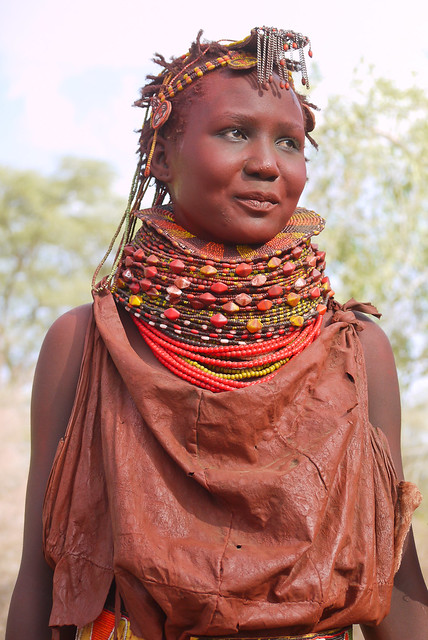
Over Easter long weekend, my friend Charlene and I took a grils' trip to Lake Turkana in Northern Kenya bordering Ethiopia and Uganda. It is the Northern-most lake in the Rift Valley, and was the set for the movie The Constant Gardener. Turkana is remote and almost completely undeveloped. Many Nairobians I know don't even consider it part of Kenya! This area is populated by the Turkana people, who are semi-nomadic pastoralists related to the Massais in the South.  

Getting to Turkana was quite the journey.  We took Fly 540 (a regional airline) to Lodwar via Kitale. It's a relatively short flight, each lag was about 1 hour.  However, when we landed in Kitale for the stopover, the plane's tire burst.  On one hand, I felt very fortunate that we landed safely since we're talking about an airstrip in the middle of nowhere.  On the other hand, we know what we'll have to deal with next.  As expected, there was no spare tire on the plane OR at the airport.  There was also not an engineer/mechanic on the ground, so even if we had a spare tire, nothing can be fixed.  So, they had to send a spare tire on the next flight from Nairobi to Kitale along with the engineer.  And since it will be dark by the time the spare tire arrives and we won't be able to take off to go to Lodwar, we all need to spend the night in Kitale.

The great thing about hick ups like this while traveling is that you become instant friends with other passenger over your shared misery.  We met a few others who incidentally was traveling to the same camp site in Turkana as we.  Knowing how absent minded people can be here, we created a buddy system with 2 American girls who were Peace Corp volunteers here, sure that this way, no one will be left behind the next morning when we need to rush out of Kitale en route to Lodwar.  Surely enough, the next morning when we got on the van to go back to the airport, the girls weren't there.  The van was running a couple shifts to take all the passenger, and we were pretty sure they weren't on the first shift.  So, being good "buddies", we held up the van and wanted to find the girls before we leave.

The way people problem solve in Africa is very fascinating to me.  Firstly, when a problem arise, even if it's a simple issue that one person can fix in 10 minutes, you will certainly find 3+ people attending to the issue.  The first person is the one who is facing/solving the problem, the second person is there to "consult", and the third person to observe/monitor.  So imagine 3 people trying to correct a simple mistake on a hotel bill...a simple algebraic problem with the help of a calculator surely can't be too difficult. However, because now 3 people are involved and they'll need to discuss and all, a normally 10 minute process can easily take half an hour or more.  The second interesting thing about African problem solving method is an extensive repetition of the problem as though if you repeatedly talk about the problem for enough times, the solution to the priblem will magically appear OR the problem will just go away.  So, going back to Kitale, as Charlene and I sat in the van, telling the driver that our friends are not here yet and they should call their hotel room #410 to make sure they come to the van, one of the Kenyan passenger asked, "your friend is not here"..."yes, that's what we said, they are not here, they are in room 410, someone is calling them".  Another Kenyan said "they didn't come?" ... "no, they have not come"..."which room are they?" ... "410"...A third person, "what room?"..."410"..."you have called them?"..."no, that's why we asked someone to call them"..."they haven't come?"..."no, they have not..."..."they didn't go with the first van?"..."no, they have not..."..."maybe they left already!"..."no, they were NOT on the first van"..."what room are they in?"..."410"..."I think they left already"..."No, we are sure they weren't on the first van"..."are you sure?"..."yes, we are sure"..."they are not in their room?"... well, this goes on, and you get the idea.  Finally, we found out that although the girls did not go with the first van, they did leave with someone else to the airport, so we went on our merry way to the Kitale airstrip right about the time the sun is rising, shining its gentle light on us.  Beautiful morning, with the added bonus of this hilarious problem-solving dialogue to set off a good day.


Thankfully, our plane was fixed overnight, and we were on our way to Lodwar.  We stayed at Eliye Springs Camp, and they sent someone to pick us.  The 1.5 hour journey from Lodwar to Eliye Springs Camp was surreal.  We drove through deserts, camels, giant termite hills with very very little amount of settlement.  Looking out of the car, the wilderness stretches as far as you can see, there was absolutely no development.  The area is completely off-grid, and getting food/water to the area is extremely difficult and expensive.  Once we arrived at the camp, we were greeted with icy cold towels and a refreshing herbal drink.  The landscape by the lake was not like anything I've seen before.  Lake Turkana is huge so it feels a bit like an ocean, the sand beach is lined with palm trees, and the climate was dry and hot.  It felt like a hybrid of sand dune and tropical beach with beautiful blue water and wildlife around.


One day we took a boat trip to Central Island National Park, which hosts a few crater lakes given the volcanoes around this area.  It was an easy hike, and the landscape was absolutely breathe-taking.  We were the only ones on the island, and it felt like we could be on the set of LOST.


The most memorable events during this trip was meeting some incredible individuals who have done incredibly adventurous and brave things in Kenya.  The Swiss owner Ralph, for example, was telling us about his challenge trying to develop tourism in Lake Turkana.  A biologist by training, Ralph first began organizing research safari in the 70's.  He eventually fell in love with Kenya and got into the safari business.  Then he got disenchanted with the safari industry as the tourists' focus of taking a safari gradually shift from the journey/adventure to the destination itself.  So he began building camp sites and got more into development work.  Up until this point, his story isn't all that uncommon; however, he began telling us the challenges he's had building/maintaining Eliye Spring Camp, and those stories sounded like they were from a Hollywood movie.

We discovered that Ralph has been frequently threatened by the community and his physical security is in serious jeopardy.  The population in Turkana is extremely poor.  The region is completely undeveloped, and being in the middle of a desert, there really is not a whole lot of resources or jobs.  Most people are unemployed and survive on hand outs from the government and the myriad of aid organizations.  The long period of dependency on aid created this weird mentality that any organization that's generating income should give the community money even if the organization is private and the community has done nothing to help advance its business.  Ralph's camp has been making losses for him, but he continued to hire local people so they have a source of income.  So far, he's hired half of the people from the village nearby, and has kept them despite of them stealing from his camp (not an uncommon problem elsewhere in Kenya).  Despite of this, there are a few youth group "leaders" who comes regularly and demand money for no good reason except the fact that they believe Ralph should contribute more to the community (a.k.a. their personal pocket).  If he does not agree to their demands, they threaten to burn his bomas or harm him physically.  In fact, the previous 2 owners of Eliye Spring Camp were both murdered by the locals.  There is no law reinforcement here, and the people are plagued by ignorance, desperation, resentment and greed.  Tribal differences can be easily used as a tool to usurp properties from one another.  People kill each other without blinking their eyes for reasons ranging from cattle raiding to pay for "bride price" all the way to killing someone to get money to pay school fees for their kids!  Normally if one wants justice, he would go to the village elders.  However, the elders in these villages are all drunkards and the communities are ruled by a handful of crooks.  The majority of the village people have no issue with Ralph, but they will not fight the crooks for Ralph since they don't know any better.  After having successfully done developments in other parts of Kenya, Ralph is convinced that Turkana is never going to be developed because in his words, these people are so ignorant and corrupt that they only see money and do not see how these work will benefit the community in the long run.  All their extortion and harassment makes investing in this region extremely unattractive and unproductive, no one in their right mind will stay here!  Ralph seem to be quite a kind person, so when he said "these people deserve to rot in hell", it really spoke volume and made me very sad that there's so little hope in a beautiful place like this that is the definition of paradise.

I couldn't help but wonder...are there people who are more deserving of aids than other?  Who has the right to judge which group is worthy of aid and which group isn't?  Can we really blame people for their ignorance and desperation?  People do desperate things in desperate situations.  I guess I haven't been in the development space for very long that I still have a lot of optimism in me.  So I believe that there's a time and a place for everything.  Maybe it's not Turkana's time yet...it may just be too much too soon right now.  Maybe the towns around it needs to be more developed first so that the Turkana people can be exposed to the impact of development little by little so that when development project do come, they can see their value and appreciate the positive impact they can bring to their community.  Give it a bit of time, maybe the impact of development will work its way to Turkana like the ripple when you drop a stone into a lake?

No matter what, it's undeniable there are A LOT that can be done here.  I asked Ralph, despite of all the hardships and challenges, why is he still in Kenya?  What keeps him inspired to stay here vs. moving back to Switzerland?  He said, "Switzerland is boring, everything is "done", here in Kenya, nothing is done, you can do so much and make an impact".  That really struck a chord with me.  For me, the "opportunities" of what more can be done in Africa (or developing countries in general) truly gets me out of bed every morning.  I don't feel like just another replaceable paper pusher in a giant money-making machine.  Even if I'm in the office, I'm actively doing something that I know will make a significant difference to the company that I'm working for, and to the community that I'm trying to impact.  I suppose the thrill of making one's mark in this world can be a bit addicting.

So what's next for Turkana?  Oil is recently discovered in Lake Turkana, apparently it's everywhere!  If one look at the history of what oil has done for African country, it hasn't exactly gotten a good track record, and has been more of a curse than a blessing.  If properly managed, this could be a significant opportunity for the region to get some revenue and build infrastructure (i.e. roads, schools, clinics) that could jumpstart the entire population into a better future.  However, with a government where politician do not think twice about selling out his country for personal financial gains and a country where illiteracy and lack of empowerment is so prevalent that the people do not DEMAND justice, I'm more apprehensive than happy about Turkana's future with this oil news.  The awe-inspiring, out of this world landscape and beautiful wildlife make Turkana the definition of paradise for me.  It would be so sad to see it turn into another Niger Delta with the big oil companies exploiting the poor and natural resources.  I pray that will never happen, and enough people in bilateral and civil organizations will garner enough voice to protect this paradise and make the best use of the resource it provides.  I sincerely hope that when I return to Turkana in 10 years, it can still remain the beautiful paradise that it is today.

Leaving Lodwar airstrip: this is the ticket counter, security screening, and baggage claim

Monday, March 26, 2012

Yet another list of must-go places...the chase never ends

So many places, so little time...

40 Unforgettable Places

Angkor Wat - Cambodia
St Petersburg - Russia
Havana - Cuba
Wat Phra Kaeo - Thailand
Grand Canyon - USA
Taj Mahal - India
Eilean Donan Castle - Scotland
The Alhambra - Spain
Aitutaki - Cook Islands
Pyramid of Kulkucan - Mexico
Venice - Italy
Dead Vlei - Namibia
Iguassu Falls - Brazil & Argentina
Petra - Jordan
College Fjord - Alaska
Karnak Temple - Egypt
Rio de Janeiro - Brazil
Taman Negara Rainforest - Malaysia
Jaisalmer Fort - India
Galapagos Islands - Ecuador
Manhattan Island - USA
Lake Titicaca - Bolivia & Peru
Monet's Garden - France

Ngorongoro Crater - Tanzania
Santorini - Greece
Drakensberg - South Africa
Zanzibar - Tanzania
Makalu - Nepal
Lalibela - Ethiopia
Machu Picchu - Peru

Uluru - Australia
Varanasi - India
Great Barrier Reef - Australia
Lhasa - Tibet
Yangshou - China
Dubrovnik - Croatia
Ephesus - Turkey
Shanghai - China
Samarkand - Uzbekistan
Killary Harbour - Ireland

40 Unforgettable Islands

The Society Islands - French Polynesia
Si Phan Don - Laos
Newfoundland - Canada
Ile de la Cite - Paris, France
Islands of Lake Tana - Ethiopia

Pico Ruivo - Madeira, Portugal
Sagar - India
Vanuatu
Isle of Skye - Scotland
Cousine & Praslin - The Seychelles
Santa Barbara Islands - California, USA
Hong Kong Island - China

Amorgos - Greece
The Golden Temple - Amritsar, India
The Florida Keys - USA
Bali - Indonesia
Southern Dalmatian Islands - Croatia
Yasawa Islands - Fiji
Madagascar
Stockholm - Sweden
Lord Howe Island - Australia
Sri Lanka
Sark - United Kingdom
Bacuit Archipelago - Palawan, Philippines
Lamu - Kenya
Big Island - Hawaii, USA
St Lucia - Windward Islands
Mont Saint-Michel - France
Tierra del Fuego - Argentina
Sicily, Italy
Mount Desert Island - Maine, USA
Svalbard - Norway
Eleuthera - The Bahamas
Ibiza & Formentera - Spain
Kubu Island - Botswana
Isles of Scilly - England
Phanga Nga Bay Islands - Thailand
Socotra - Yemen
Tokyo's Parks - Japan
Rapa Nui - Chile 

Monday, March 19, 2012

Kenya Nzuri: Lake Baringo & Lake Bogoria


For my lovely friend, Charlene's birthday, a group of us took a trip to Lake Baringo and Lake Bogoria.

Lake Baringo has a surface area of about 130 square kilometres (50 sq mi) and an elevation of about 970 metres (3,180 ft). It is one of two freshwater lakes in the Rift Valley in Kenya (Lake Naivasha being the other one, also stunningly beautiful).  It is the home of over 470 species of birds and is a perfect place for bird lovers!

We stayed at a place called Robert's Camp.  It's basic, but charming.  I love the porch area, despite of the mosquitoes.  At night, hippos come to the camp site, and one of the night we were able to spot some of them grazing.  The climate was pretty hot and steamy when we were there, but we were able to just veg out and do absolutely nothing.  I think this is the first time I can understand what it is like to live in the South in the US when the temperature is high and air is humid!  


My favorite part of the weekend was all the birds and wildlife that just comes into our camp.  All sorts of colorful birds were around us, and we've successfully lure some to come near our porch with some delicious chevda.  It's quite interesting to witness the pecking orders of the various species of birds, some are timid, others are mean and ruthless.  I suppose, not that different from humans. :-) 


On the way back to Nairobi, we stopped by Lake Bogoria.  It is a saline, alkaline lake that lies in a volcanic region, and is home to one of the world's largest populations of lesser flamingoes. Lake Bogoria is also famous for geysers and hot springs,  It contains the highest concentration of geysers in Africa (at least 18 is known).  Despite of the extreme heat, the steam coming out of the hot spring by the bank of the lake was actually really refreshing, and there were a few local Kenyans sitting there enjoying their "sauna".  We cooked some eggs in the hot spring, which totally reminded me of my childhood in Taiwan where we would go to a local hot spring and do the same.


So another beautiful, fun weekend away from Nairobi has ended.  I feel extremely lucky to be able to make my tour around Kenya and explore its unspoiled beauty, this is something most Kenyan don't get to do, and hopefully through my posts the world can see how great Africa is and eliminate some of the negative, depressing images most Western media portray.

Monday, February 20, 2012

Kenya Nzuri: Mount Suswa

Completely off the beaten path and unimpressive from the outside, Mount Suswa is comprised of a massive double crater system and possibly one of the best hidden gems near Nairobi.  Suswa is the least known of the three famous Great Rift Valley volcanoes (the other 2 being the nearby Longonot and Menengai in Nakuru).  The summit is 2,356m (7,730ft) and affords a breath-taking view of pure beautiful nature.  
View from the turn off the tarmac towards Mt. Suswa, simply stunning!
Daniel, our Maasai guide...he gives guide to tourists, and even has his own blog

We spent a night camping at the rim of the outer crater.  The Maasai killed a goat and prepared some nyama choma (roasted meat) for us all from scratch...I never realize how much meat is on a tiny little goat until that night; it was a yummy, rustic feast!   

our little outdoor kitchen :)

our outdoor nyama choma...the meat glistened next to the fire, it's probably the most beautiful piece of meat I've ever eaten

The next morning we followed our guide, Daniel, up the mountain...The view from the hike was simply breath-taking, as far as being close to nature goes, this probably can't be beat!

beautiful view of the Great Rift Valley from the top


Sunday, February 12, 2012

Kenya Nzuri: Kakamega: the mystic forest

Kakamega forest is the only remnant in Kenya of the once great tropical rainforest that stretched across Central Africa, also known as the Guineo-Congolian forest. About 10,000 years ago when the climate became drier the area of the rainforest shrank to what it was about 250 years ago. With time, much of the indigenous forest has been cut down as people needed the land for farming and Kakamega forest has become an exotic isolated relic of this vast African equatorial jungle, making it a unique habitat in Kenya. To the local Luhya people, Kakamega forest has not only been a generous supplier of firewood and building materials for centuries, medicinal plants are being used to heal all kinds of illnesses. Due to commercial exploitation and increased population in the area the future of the forest was uncertain untill two nature reserves (Yala and Isecheno) in 1967 were being created and in 1985 two more reserves in the northern part of the forest (Buyangu and Kisere) were being created, somehow reducing the pressure on the forests natural resources. [excerpt on Kakamega from Africa-expert]

I've been wanting to visit Kakamega for a loong time, and finally, we made a trip there to visit the mystical forest.  Kakamega is famous for its biodiversity and butterflies.  We arrived during dry season, so there isn't much butterflies; however, there are still plenty of monkeys, birds, bats...etc.  


Great Turaco in Kakamega forest

We stayed at the beautiful and serene Rhondo Retreat...a bit of a splurge vs. my normal backpacking accommodation, but it's well worth the $50/night, which includes breakfast, afternoon tea, lunch, and dinner.  The place felt very colonial (like many other cottages in Kenya), but that didn't really bother me.  This may be a bit premature to think about considering I'm only in my 30's, but places like the Rhondo Retreat feels like the perfect retirement spot!  Labor is cheap (hence you can hire ppl to take care of the place), the weather is perfect, the food is fresh, air is crisp...imagine owning a place like this, rent it out to tourist to generate some income, and save a room or two for yourself.  There's nothing more serene and relaxing than waking up to the birds chirping, breathing in fresh air while listening to the sound of the wind blowing through the leaves, and occasionally spotting monkeys moving from tree to tree....Life can be nothing but beautiful in places like this :-)

chilling at the porch...spotting Columbus monkeys

Photos courtesy of Neeta Bhandari and Mark Rolland

Saturday, January 14, 2012

Amazing adventures of a nobody

Amazing Adventures of a Nobody

Whatever you can do, or dream you can, begin it.  Boldness has genius, power, and magic in it - Goethe

Leon Logothetis was running a business in the UK.  He was jaded, burnt out, and felt out of touch with others.  So he made a bold decision; he left his job, and decided to travel from New York City to Hollywood on $5 a day.  He forced himself to connect with people, and was able to make this amazing journey relying on the kindness of strangers.

I recently read his book about this life-changing experience.  While I will never have Leon's bravado to embark on a similar adventure, the thrill from a sense of "danger and generosity intertwined" was something I could relate to from my own travels.  I think the "danger" often time originate from a combination of the reality (e.g. political instability, poverty, being the obvious foreign tourist target...etc.) as well as our own biased perception of our travel destination tainted by horror stories or what we see on the news (e.g. Africa being the dark continent with poor people everywhere, corrupt immigration officers...etc.).  In a way, the danger in traveling to foreign, particularly developing countries, is quite real, but I think many time it's blown out of proportion by our own ignorance and tainted view from subjective descriptions of the places.  I think this is what makes the "generosity" feel that much more endearing when we experience it.  It hits us at the most unexpected moments, and as a result, make the deepest mark on our hearts.

I also found a few other things Leon mentioned in the book quite thought provoking on a personal level: 

[why we travel]
  • Hypothesis 1: "the reason we like travelling so much is because it places us in a position of control we don’t often find for ourselves in our daily lives.  When we are home in our routine, we go where we’re told, or where we must, on someone else’s time, at someone else’s pace – to work, to school, to the shop…but when we travel, we go where we wish"
  • Hypothesis 2: perhaps we "travel to run away from the only ones who could hurt [us]. Traveling was a way to be safe and alone." I think there could be a grain of truth to this observation.  I find some chronic travelers, particularly those after their mid-30's, almost are in this endless search of something else.  They are constantly moving from one destination to another, which means a lot of short, enjoyable relationships with locals and fellow travelers, but very few of those relationships have staying power.  While I would agree that those relationship could be meaningful connection, the level of commitment from these relationship cannot be compared to someone from your home country, who's known you for several years, and will pick up your call late at night to hear you vent about something.  Sometimes I wonder if some of us constant travelers are searching for something or are actually running away from something, someone, or some situation?
[how we travel]
  • De-emphasize the destination: "The destination is the obstacle; it draws such attention from us that we aren’t allowed to think about what happens in the middle, between here and there." I definitely find this more and more true as I travel more and get older.  While the "sites" are still very interesting, I noticed that the little incidents and various experiences en route to the sites are often what I remember most fondly upon after I return.  After all, I can always download a photo of the rice terraces in Sapa, Vietnam, but the people I met on the train ride there was what made the trip most special and cannot be replaced!
  • Mode of transportation: "Efficiency is the enemy of connection.  We have connected less and less; talked less and less…Now, the journeys are just about speed – getting someplace as fast as possible."   Consider slower mode of transportation, it helps allows us to connect with others and enjoy our surrounding more.  
Amazing Adventures of a Nobody is a quick, easy read, and probably would resonate with many young professionals who feel disenchanted and wants more.  I think one may not need to do what Leon did to find happiness.  Traveling might not even be the right approach to get there.  However, I think the element of human connection and boldness to go after one's dream are key component to life's content. 

Sunday, January 8, 2012

Ethiopia, a land with much much more than 13 months of sunshine!


Ethiopia is probably one of the most interesting country I've visited (and one I would go back again).  There are simply so many things to see and do in Ethiopia that our 10 pitiful days just can't do it justice. So, I decided to split up the trip into 2: first do the Northern historical circuit visiting Bahir Dar (a lakeside town with many monasteries), Gondar (the last capital), Lalibela (capital before Gondar famous for its rock-hewn churches), and Axum (the earliest capital for the Axumites, with mysterious stalaes); then do the Southern Omo Valley + Harar (the 3rd holiest muslim city famous for tamed hyenas roaming around town) in the summer.
Despite the short trip, the land of Habesha already mesmerized me beyond imagination.  It has one of the most awe-inspiring, unspoiled landscape I've seen

Beautiful Lake Tana in Bahir Dar
The Magnificent Simien Mountain Range


In addition, one can observe rich history, deeply-rooted culture and national pride in Ethiopia.  Ethiopians believe that they are descendants of King Solomon as described by the book of Kebra Nagast.  It described how Queen of Sheba met Solomon, gave birth to Menalik I, as well as how the Ark of Covenant arrived in Ethiopia as God's intended place for the Ark's final resting place.  This special connection gave rise to tremendous pride for the Ethiopian people, and as we visit around the many churches and monasteries, we see more and more mystical elements connected to (but not described in the Bible) which made the Ethiopian Orthodox Tewahedo Church that much more mysterious and intriguing.

Castle in Gondar
Intriguing Stelae in Axum


Remote monastery around Lake Tana
Beautiful religious paintings found all over Ethiopia
   
St. George's rock-hewn church in Lalibela
Proudly passing the "I have not sinned" test in Lalibela


It's not surprising, with the amount of churches around the country, that religion is deeply rooted in the lives in Ethiopia (at least in the towns we visited in the Northern circuit).  The dedication people have for their religion and God is admirable.  We were visiting just a few days before the Ethiopian Christmas and the Epiphany celebration, so pilgrims from around the country were just gathering in various holy places.  People walk miles and miles to get to be part of this celebration; given the heat and dusty condition, if that is not dedication, I'm not sure what is.


Being one of only 2 African countries never been colonized (the other being Liberia), Ethiopians are able to maintain its traditions and strong identity.  As a ferengi (foreigner in amharic), it is also extremely refreshing to visit an East African country where I am treated as an equal rather than an assumed superior individual (given my "foreigner" credential).  While the "you are a wealthy tourist, give me some money" mentality is understandably still there, and that we still get a lot of attention and constantly hassled by people going "you! you! you! you! you!", the awkward African and non-African social divide so prevalent in the rest of Africa seems to be missing in Ethiopia, and that was very nice.


And of course, the normal developing country hustle and bustle 


as well as things that makes you scratch your head can also be observed here.  We expected crowded bus rides, the pro is that for some reason, although equally pungent, B.O. seem less prevalent among Ethiopians (compare to Kenyans). The con is that the infrastructure is also less developed in Ethiopia.  Buses are old and constantly breaking down (4 times for our ride from Gondar to Axum).  Roads are dusty, bumpy and dangerous.  And all sorts of things get carried on public transportation: 5 guns, 1 huge carpet, several bags of grains to name a few from our trip (the only thing we were missing were some livestocks).  The prevalent of firearms carried by average civilians was particularly intriguing to me.  Given the crowded (and bumpy) condition, there were several moments I thought the guns have a high chance of misfiring, and that will be the end of me.  However, it seems like us foreigners were the only one concerned about guns on board.  The Ethiopians were so nonchalant about it that at one point, some guy literally asked another unaffiliated passenger next to him to hold his gun while he can make a phone call.


My travel-mate Toba summed up the highlights of our trip best appropriately to the tune of 12 days of Christmas (since we were traveling over Christmas):


The 12 Days of Ethiopia
(although the trip was technically 10 days)
1 bus a blazing
2 pans of coffee beans a roasting
3 bottles of tej and angry men a staring
4 traveling ferenge (foreigner in Amahric)
5 armed men
6 trotting donkeys
7 pantless men a waving
8 gelada baboons a roaming  
9 images of st. george a fighting
10 you! you! you!
11 rock hewn churches
12 fasting meals


Amesegenallo, Ethiopia! I shall be back!